
The Escape Theory: What Will Actually Break the Corporate Power-Law?
Recently, I attended a fireside chat with the CTO of Wise and the Chief Research Scientist of Pactum. I asked them a provocative question:
Do you see any technology on the horizon that could fundamentally disrupt the market’s power-law distribution by decentralizing and empowering individuals in such a way that they no longer need companies?
For context, Wise built its empire by decentralizing cross-border payments — much like blockchain aims to do. Now, AI is doing the same to traditional SaaS. I wanted to know what else could break the massive corporate monopolies we all depend on and if software is now free, what are the moats that remain.
Their answer was predictable: they don’t currently see any technology significantly impacting the fundamental structure of the market. I expected this response, but I asked the question to provoke a deeper dive into what theoretically could.
Historically, humanity's evolution has always been driven by increasing specialization. We focus on smaller pieces of work, and corporations scale these layers globally to decrease costs. This naturally leads to a power-law distribution: a centralized economic machine where a few monopolies dominate, and the rest of us become highly specialized, dependent nodes.
The Illusion of the Market's Immutable Structure
But what if the future of technology doesn't break this market structure directly? What if, instead, it allows you to escape it?
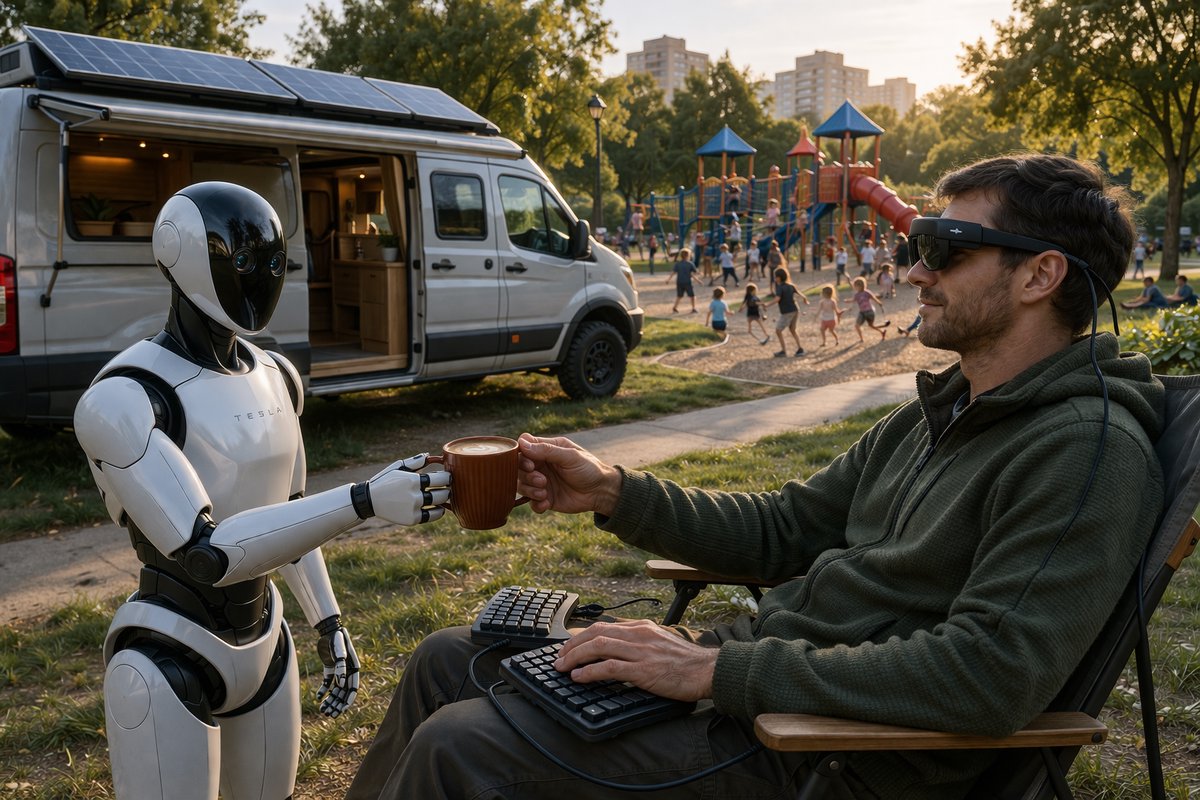
Escaping the Digital Monopoly
Right now, AI enables a single developer to build entire systems from scratch, breaking dependencies on big software providers. SaaS as a pure software play is effectively dead.
But there is an even stronger push factor driving us away from traditional digital layers: the very emergence of AI is degrading the platforms we currently rely on. Social media, professional networks like LinkedIn, and even dating apps are increasingly flooded with AI-generated content and synthetic personas. We are constantly bombarded by bots trying to extract value from us, driven both by corporations and by individuals seeking leverage for personal projects.
Soon, it will be impossible to know if you're interacting with a real human without external help. To combat this, we will likely see a massive rise in the necessity for identity verification and bot-protection. Estonian startups are already tackling this: companies like Veriff are building robust identity verification systems, and Private Captcha is focusing on distinguishing humans from automated bots. Eventually, we might be forced into invasive, government- or corporate-sponsored identity verification, or into a model where all content contribution requires a direct financial payment, regardless of whether you are human or bot. This hyper-commercialized, synthetic wasteland is the exact friction that will push people to seek an exit from centralized platforms entirely.
The Physical Escape
But it won't stop at software. Look at the physical world:
- Food: Startups like ÄIO are synthesizing future-shaping fats, oils, and molecular food from wood byproducts, bypassing traditional agriculture.
- Mobility: The corporate travel model relies on heavily centralized layers (airlines, hotels). But with 100km+ e-bikes from companies like Ampler and fully self-sufficient motorhomes, an individual effectively owns a personal spaceship, allowing them to explore the Earth off-grid.
- Energy: We are actively shifting from fossil fuels to renewables and modular nuclear reactors. Imagine a future where you have a personalized, safe micro-reactor powering your home or car—a scaled-down vision of what Fermi Energia is pioneering. Or the ability to collect so much solar and wind energy that you can live off it year-round, storing it in advanced supercapacitors like Skeleton Technologies or converting it into liquid hydrogen or methane via advanced fuel cells like those from Elcogen and microtubular solid oxide fuel cells from GaltTec.
- Hardware & Self-Reproducing Robotics: When humanoid robots arrive, big tech will try to lock them down. But an open-source hardware movement is inevitable. The ultimate endgame is self-reproducing robots. If a consumer can buy one open-weight robot that can mine resources and build a copy of itself, dependency on massive manufacturers drops to zero.
When you can write your own code, synthesize your own food, travel in your own off-grid "spaceship," and command a self-reproducing robotic workforce—you no longer need to buy corporate services. You simply evaporate from the traditional market.
The Moats: Complexity and Resources
Yet, there are massive obstacles preventing this emergence. The primary moat keeping monopolies alive is the hyper-complexity of modern technology and the global distribution of resources. Consider the famous essay "I, Pencil": not a single person on Earth knows how to build a simple pencil from scratch because it relies on a vast, interdependent supply chain. The same is exponentially truer today. Can a single human produce an AI chip? Absolutely not. Your computer's components are manufactured across dozens of countries. How can you, as an individual, be truly self-sufficient when the tools required for self-sufficiency demand the entire global economy to produce?
For the "escape" to work, technology must become a closed loop that an individual can master without relying on a corporation as a constant dependency. We are seeing early glimpses of this. AI can now replace third-party libraries, allowing you to write your own operating system and run it on modular, user-repairable hardware (like Framework laptops). The goal isn't necessarily to build a microchip from sand in your backyard; it's to reach a critical threshold of modular, open-source building blocks that don't forcefully expire or lock you into a corporate ecosystem.
Another critical constraint is energy and resource reliance. Moving away from fossil fuels to renewable sources or hydrogen storage still requires massive amounts of rare Earth metals and complex manufacturing. Can you actually be self-sufficient in energy if your solar panels require global supply chains to replace? The solution might lie in how we handle waste. Instead of producing waste that requires external management, true off-grid systems might thrive by harvesting the waste of others. Microplastics are so prevalent in the environment that an autonomous system might simply filter them from water to 3D-print replacement parts. Or, more ambitiously, extract trace minerals—like filtering seawater for gold—to secure the rare elements needed to sustain its own energy cycle.
The Final Frontiers: Immortality and Space
But what if we look even further? There are two massive, far-fetched disruptors that could shatter the power-law entirely:
- Biotech & Infinite Lifespan: What happens when we can replace failing biological organs with synthetic ones? Or embrace transhumanism by digitally scanning and simulating the brain? We recently managed to map and simulate the complete brain connectome of a fruit fly. While it requires immense compute today, the theoretical possibility of digital immortality exists. If the majority of the population lives infinitely, the fundamental driver of the economy—time scarcity and biological maintenance—collapses. Infinite time changes consumption entirely.
- Space Colonization: Expanding to other worlds breaks the closed-loop constraints of Earth, creating entirely new frontiers where Earth's power-law monopolies hold no jurisdiction.
Beyond economics, this extreme independence will profoundly impact the social fabric, particularly how we form families. We are already seeing the early stages of this. As economic independence—especially for women—has increased, the financial necessity of staying in a family unit has vanished. Families are no longer held together by economic pressure; instead, they are built on personal choice and genuine connection, which is undeniably healthier.
However, as extreme self-sufficiency scales through technology, what happens to human reproduction? If individuals become entirely autonomous, the societal mechanism of interdependence breaks down. We might see a world where the fertility rate plummets even further because the traditional structures and pressures that encouraged large families simply evaporate. Humanity could become a self-regulating system that gracefully shrinks as it reaches peak independence.
The End of Wars vs. The State's Retaliation
If people become fully independent, does it mean wars will end? If you have everything you need, why collectively attack a group of people? There is no longer a need to conquer resources, aggressively spread democracy, or enforce religious ideologies. You wouldn't even need to fight for the land you live on if you can freely move anywhere without losing your quality of life.
But this exact nomadic, self-sufficient lifestyle poses an existential threat to governments. A population that cannot be taxed, heavily regulated, or tethered to traditional education and economic systems challenges the very foundation of the state. Will governments and global corporations simply let this happen? Highly unlikely.
But the system doesn't only rely on laws to keep you tethered; it relies on time and responsibility. There is a brutal paradox to this escape. If you are poor, you are locked into the economic system simply to survive. If you manage to become wealthy enough to actually buy the instruments of self-sufficiency—a high-tech off-grid motorhome, a secure bunker, advanced robotics—you are now locked in by your own success. You likely own a company, manage assets, or hold an important societal position. You cannot simply walk away without immense consequences. By the time you can finally afford to sever these ties and "escape," you are likely in your 60s, 70s, or 80s. At that point, your exit doesn't disrupt society anymore. The system has already extracted your most productive years, and your departure becomes irrelevant.
We are already seeing artificial limitations on freedom. In many parts of Southern Europe and the US, it is illegal to simply park your car and sleep in the woods. To preserve the status quo, authority, and taxation, we will likely see a dramatic increase in AI-driven surveillance and draconian laws specifically designed to prevent free movement. Governments will artificially limit extreme independence just to keep people reliant on the system.
The Ideological Awakening
But this brings us to the ultimate realization. Market disruption might not be purely technical; it might be ideological.
The hardest question isn't whether extreme self-sufficiency or infinite lifespans are technically possible. It’s about human desire: If humanity achieves the ability to be fully self-sufficient, automated, and immortal, what kind of future do we actually want to build?
Will these autonomous individuals interact to create a new, hyper-diverse mesh economy? Or will they undergo an ideological awakening, simply "evaporating" from consumerism entirely?
Is technology building a better future for everyone, or just the ultimate exit door?